
Boulder County Directory Collections
The strongest Boulder County city directory search starts with the collection and year, not a broad name query. The identified indexes were prepared by Ella M. Travis and are held digitally and in hard copy at Carnegie. A broad historic-district source documents Boulder City directories from 1892 through 1983, while the local-history guide describes directory holdings from 1892 through the present. Exact annual availability after the identified index items still needs a library check.
| Collection | Years | Where held | Access and use |
|---|---|---|---|
| Boulder and Longmont index | 1892 to 1898 | Digital local history and Carnegie | Name and address index; call numbers 997-2-1 through 997-2-4 |
| Boulder City index | 1901 to 1903 | Digital item and Carnegie | Item islandora:89643; inspect scan or ask for help |
| Boulder County index | 1904 | Carnegie and local-history collection | Boulder, Lafayette, Longmont, and Louisville named |
| Boulder City indexes | 1905 to 1908 and 1911 | Carnegie and digital collection | Verify each year and item before citing completeness |
| Travis county and business volumes | 1935, 1940, 1947 | Carnegie Bob and Ella Travis material | County, rural, business, and institutional context |
| Boulder City run | 1892 to 1983 broad range | Carnegie and historic-district documentation | Publisher and exact annual shelf run not fully enumerated |
Years in the table are source statements, not a guarantee that each page, town, or volume is digitized. Keep the collection title, year, call number, and access mode with each result.
Boulder County 1904 Directory Index
The 1904 county index is especially useful because it is broader than the city-only runs. It names Boulder, Lafayette, Longmont, and Louisville, giving a researcher a way to compare town labels in one county-era source. The entry remains a historical publication clue. It does not show whether a person owned the address, how long the person stayed, or whether every household in the county appeared.
Town labels deserve care. Erie, Lyons, Nederland, Jamestown, Ward, Niwot, Hygiene, Gold Hill, Gunbarrel, and other places may be classified differently by a source and year. Compare the printed town with a map, a deed, a newspaper, or an assessor card. A current municipal boundary cannot be projected backward without evidence.
A 1904 entry that looks absent from a modern search may still be useful. Search the exact historical spelling, then test the street against the street-name history. This is where a city directory contributes a time-stamped address clue rather than a current resident claim.
Boulder County Digital Directory Index
The digital local-history archive makes part of the Boulder County city directory shelf easier to inspect from a distance. Collection 997 identifies the year ranges and call numbers, and the inspected item islandora:89643 is titled a Boulder City Directory index for 1901 to 1902 while its description spans 1901 to 1903. That title and description difference should be preserved in a citation rather than silently merged.
The digitized Boulder directory index collection is the source for the collection scope. A metadata page can lead to an index or scan, but the presence of a digital record does not mean every page or abbreviation key is online.
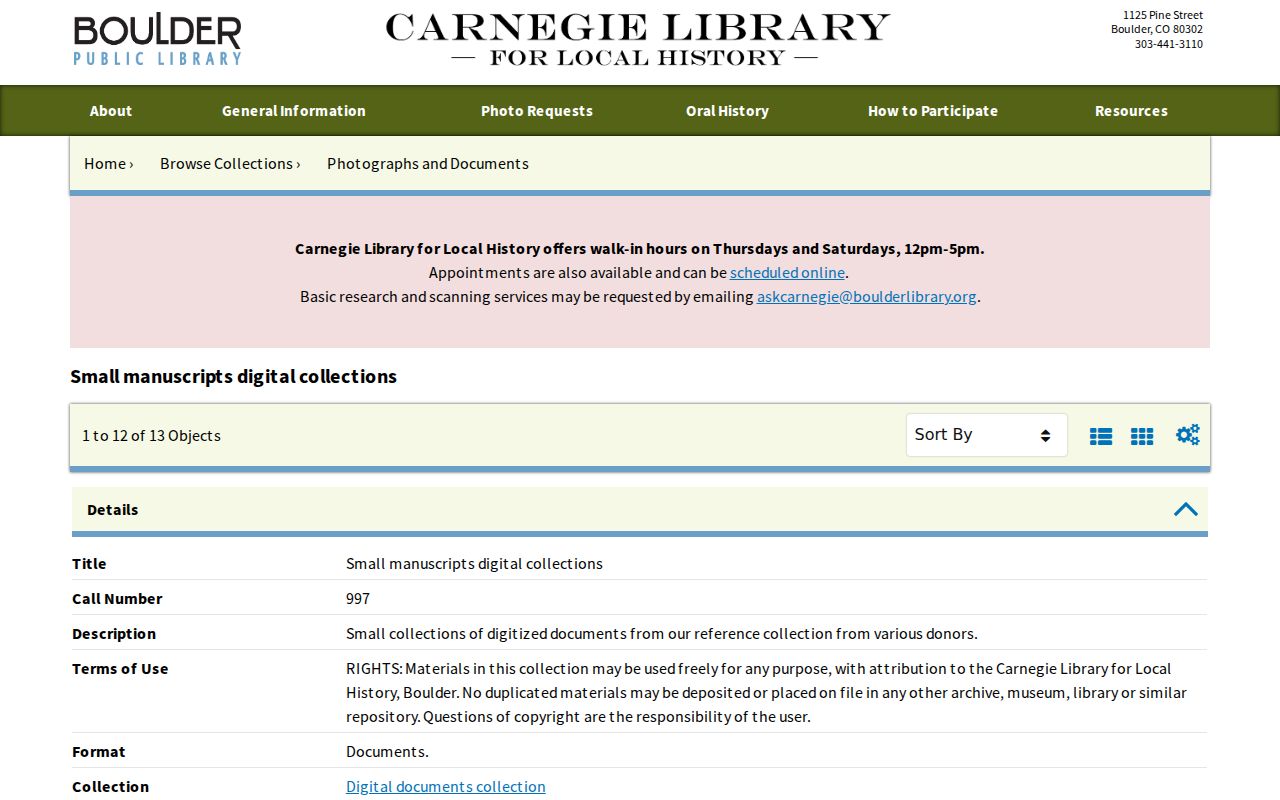
The collection image belongs beside the call-number detail. When a name is hard to read, ask Carnegie for the hard copy or a scan and cite the item identifier.
Boulder County Carnegie Directory Room
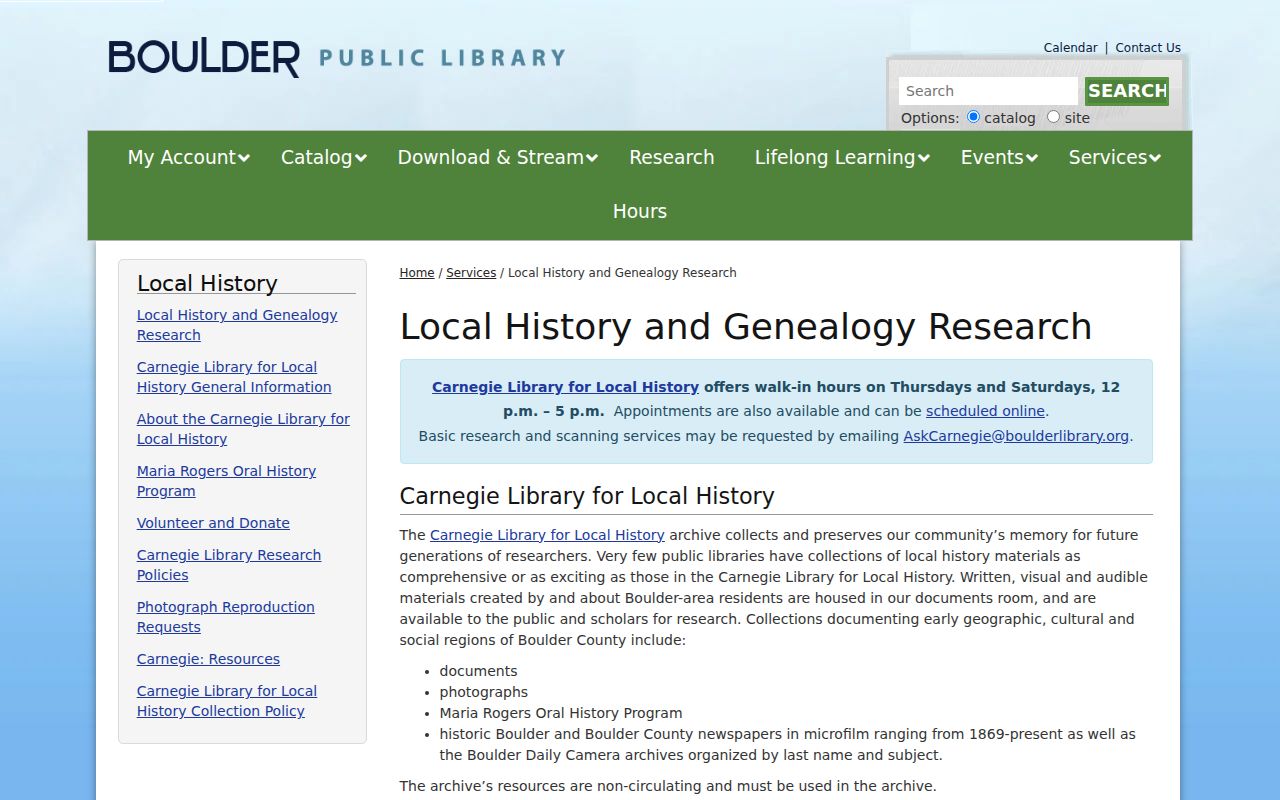
Carnegie Library for Local History is the practical handoff when a digital city directory search stops at metadata. The collection includes local newspapers, microfilm, obituary indexes, mortuary and burial records, church histories and directories, oral histories, maps, photographs, building files, and directory material. The library warns that its catalog shows only a fraction of holdings.
Walk-in service is listed Thursday and Saturday from noon to 5. Appointments are listed Tuesday, Thursday, and Saturday in the time blocks described by the library. Written inquiries should name the person, date or era, place, sources already checked, and desired result. Staff research is limited to up to one hour per topic under the inspected policy. Copy rules also matter: the first ten copies are free, then black-and-white and color rates apply, with mail or email requests limited to ten pages.
The Boulder Library local-history service gives the current collection and inquiry route. Its capture shows a research room that functions as a shelf, archive, and staff handoff rather than a simple search box.
Carnegie is also the place to ask whether a separately titled reverse directory, telephone run, yearbook, or current volume exists. The inspected pages did not confirm those runs, so they should not be invented.
Reading Boulder City Entries
A historical city directory entry should be transcribed as a publication record. Preserve the printed name, street and number, town, volume year, page or call number, and whether the source is an index or a page image. Occupation, spouse, owner mark, or abbreviation may appear in some runs, but the inspected official pages did not expose a complete abbreviation key. Do not fill in a missing symbol from memory.
| Entry element | How to handle it |
|---|---|
| Printed name | Keep initials, spelling, married name, and “et al.” exactly as shown |
| Address | Copy street and number, then record a modern form separately if verified |
| Year and town | Label the publication year and whether it is city, county, rural, or business material |
| Occupation or status | Transcribe only what the page shows; do not infer a current role |
| Owner mark or abbreviation | Check the volume key or request a library explanation |
| Source state | Distinguish metadata, index, page scan, or hard-copy consultation |
- Criss-cross directory
- A reverse-style directory arranged by address or street. A separately titled Boulder volume was not verified in the inspected pages.
- Householder index
- An index that points from a person or household name to a directory entry or address.
- Abbreviation key
- The volume's explanation of short forms and symbols. It should be checked before interpreting an entry.
Tracing Boulder Households Across Years
Directory years can show movement, household change, or a gap in publication. Follow the same name across consecutive volumes, but do not treat disappearance as proof of death or departure. Compare the address, town, spouse or family clue, occupation when printed, and the source's completeness. Pair a directory with a census or another dated record instead of stretching one entry beyond its year.
- Start with the first year and exact printed name or address.
- Check the next available city or county volume and note every street-number or town change.
- Use a map or plat to test a renamed street before normalizing the address.
- Pair directory gaps with BGS census indexes for 1860, 1870, 1880, 1885, 1900, or 1910 where the period fits.
- Close the historical trail with a newspaper, obituary, cemetery, deed, or eligible vital-record request.
The modern parcel layer belongs to a different record family. The current owner field can help locate the property, but it cannot rewrite a historical directory entry. For current address-keyed work, use the Boulder County street directory route.
Boulder County Directory Maps and Cards
Carnegie collection 880 holds Boulder real-estate appraisal cards from 1929 through 1965 and is being digitized. The house-history guide also points to building documentation, maps, plats, Sanborn maps, ownership records, photographs, landmark files, and directories. Together, these sources can bridge the gap between a printed city directory address and the parcel later shown by a modern map.
Use the historical address first. Then compare the card's address or owner clue with a deed index, legal description, plat, newspaper, or directory year. Collection access varies, and the inspected research did not provide a complete card-by-card online index. A reference to collection 880 is therefore a research lead, not a claim that every card is immediately viewable.
Note: A map can resolve a street name, while an appraisal card can add property context; neither alone proves who occupied a home.
Boulder Newspapers and Obituaries
Newspapers give a city directory entry a human date and event. Carnegie lists Boulder and Boulder County newspaper microfilm from 1869 to the present, Daily Camera surname and subject archives, and obituary indexes spanning 1859 to 1925 and 1960 to the present. The Boulder Genealogical Society lists Daily Camera decade indexes, including 1901 to 1910, portions of the 1950s through 1970s, and full obituaries at Carnegie for 1975 to 2017 according to its inventory.
Capture the title, issue date, page, column, and whether the item is an obituary, death notice, funeral notice, memorial, or paid notice. A newspaper may name relatives, a service, cemetery, funeral home, or address, but it is not automatically a certified death record. Pair it with a cemetery index, deed, directory, census, or eligible county certificate.
The BGS research route says paid research is $10 per hour plus copies, postage, and parking. Verify current policy before sending a request. A date and page makes a library inquiry much more useful than a bare surname.
Boulder County Cemetery Gaps
Burial indexes can explain why a city directory trail ends, but cemetery coverage is uneven. Columbia Cemetery's early records are incomplete and draw on ledgers, county records, mortuary records, census, obituaries, and estate files. Erie Mount Pleasant Cemetery history says records before 1901 are nearly absent, headstones are a primary source for that period, and 1960s interment records are incomplete.
That candor is useful. A missing cemetery result should be labeled as a gap, not a negative identity fact. Record the cemetery, section or location when available, source date, and whether the result is an index, ledger, headstone, or map. Then return to the newspaper and directory years that bracket the event.
Boulder County Fire and Directory Gaps
Boulder County's original courthouse was destroyed by fire in 1932, after an 1882 cornerstone and before the 1934 replacement. That event does not erase every record, but it changes how a missing name should be read. A deed may survive in another series, while a court or county administrative file may have been lost, transferred, or never indexed online.
For a pre-1932 person or address, compare the city directory with Carnegie newspapers, the Colorado State Archives finding aids, the Archives birth-record request guidance, the county birth application when an eligible certificate question remains, the recorder index, a cemetery, a map, or a municipal file. Historic Boulder and landmark sources may add building context. The gap is part of the source history, not an invitation to fill it with an unsupported story.
Recent preservation context can also matter. The current courthouse is a 1933 Glen H. Huntington WPA Moderne and Art Deco building and remains a government seat, but it no longer houses the actual courts. The 20th Judicial District and Clerk & Recorder have separate routes.
Boulder County Directory Limits
A city directory is a dated publication. It can list a person at an address, but it does not certify a residence, prove ownership, or show every member of a household. It may omit rural places, use a town label that later changes, or preserve an old street number after a renaming. A digital index can also be incomplete or hard to read.
Use the minimum claim supported by the source: “listed at” for a directory, “recorded party” for a deed, “owner field” for an assessor result, and “hearing row” for a docket. Cite the year and collection. If the question shifts to one current person, the Boulder County resident lookup uses a separate verification workflow.
Family-history use. Historical directories are strongest when they connect a name, place, and year. Keep private details out of a published transcription and confirm the source with the holding library.