
Finding Boulder County Residents
No single public roll lists everyone living in Boulder County. The useful trail splits by custodian and purpose. Property Search shows an assessor owner and mailing field tied to a parcel. The recorder shows a person as a grantor or grantee in an instrument. Elections data may carry authorized registration or voting-history fields. A court docket shows a hearing row rather than a complete case file. A directory entry, obituary, cemetery index, or newspaper page rounds out the historical picture.
Start with the strongest fact already in hand. An address points toward the assessor, GIS, Treasurer, and recorder. A name needs a second anchor. That could be a town, year, parcel, spouse, case class, or document number. Family-history questions usually belong with Carnegie and the Boulder Genealogical Society. A digital local-history archive can also help. So can a cemetery index and State Archives finding aids. Treat no result as proof of current residence without a source date and context.
- Write down the name or address exactly as known, including initials, town, and likely date.
- Use the county Property Search or map to find the parcel, account, legal description, and owner field.
- Check the recorder index for grantor, grantee, document type, date, and legal-description matches.
- Use the Colorado voter route, court docket, or a record-specific state portal only for the question that source can answer.
- For an older household, pair a directory, newspaper, cemetery, census, or appraisal card with a second source.
Boulder County Records Desk
The residents directory trail in Boulder County crosses county and municipal lines. The Clerk & Recorder keeps recorded instruments and licenses. The Assessor maintains parcel context. Elections publishes products with protected fields removed. Boulder County also runs countywide courts, taxes, and public health records. Boulder, Erie, Lafayette, Longmont, Louisville, Lyons, Nederland, Superior, Ward, and the smaller mountain and plains communities keep their own municipal records. A city agreement or planning file never moves into the county recorder just because the property sits in Boulder County.
Boulder County Elections
1750 33rd Street, Suite 200
Boulder, CO 80301
303-413-7740
City actions belong with the municipality's clerk or records custodian. City of Boulder Central Records lists ordinances, resolutions, board packets, easements, contracts, leases, open-space acquisitions, and annexation or development files. County deeds, liens, and plats remain recorder material.
Boulder County Property Search
The county property portal is the quickest parcel-based starting point. It is a natural first stop for a Boulder County residents directory search. It accepts an address, owner, street name, subdivision, account, parcel, section-township-range reference, or map click. A result can connect an address to an account and legal description. From there it offers property, assessment, deeds, zoning, floodplain, and elections reports. The owner name comes from deed records. Even so, the owner field and mailing address do not establish occupancy. They cannot confirm who currently lives at the site.
| Search control | What it returns |
|---|---|
| Address or street | Situs property match, street grouping, account, and parcel context |
| Owner | Assessor owner field and linked property result |
| Subdivision | Parcel grouping by the named subdivision |
| Account or parcel | Exact county identifiers for a property record |
| S-T-R | Section, township, and range legal geography |
| Map and reports | Parcel selection plus property, deeds, zoning, floodplain, and elections reports |
The result also separates situs address, mailing address, neighborhood, market area, sales history, building details, estimated taxes, and district information. Treat those as separate fields. A mailing address can belong to a person or organization far from the parcel. A map boundary is not a survey. For street-by-street work, the Boulder County street directory follows this parcel chain in greater detail.
Note: The assessor says it updates more than 120,000 properties every two years, but the portal does not state a historical cutoff for every field.
Boulder County Deed Names
The Boulder County Clerk & Recorder is the main historical-name route. It serves people tied to real-estate instruments. The office says its records date to 1860. The public search accepts grantor or grantee, document type, subdivision, document number, and recorded-date ranges. It also offers either index-only or index plus OCR full-text search. Categories span deeds, deeds of trust, liens, foreclosure documents, plats, and maps. They also include marriage licenses, civil unions, mining claims, assignments, covenants, and UCC filings.
A deed party is not automatically the current owner or resident. Search the grantor and grantee sides separately. Preserve the reception or document number. Read the legal description before tying a name to a parcel. Watermarked images can be viewed through the public route. Clean digital and certified copies follow separate request and fee paths.
Records dating back to 1860 are described by the Boulder County Recording Division. Its public search screen includes date presets from the last day through one year. It also has an OCR option. The official recording page displays the full search context for grantor and grantee work.
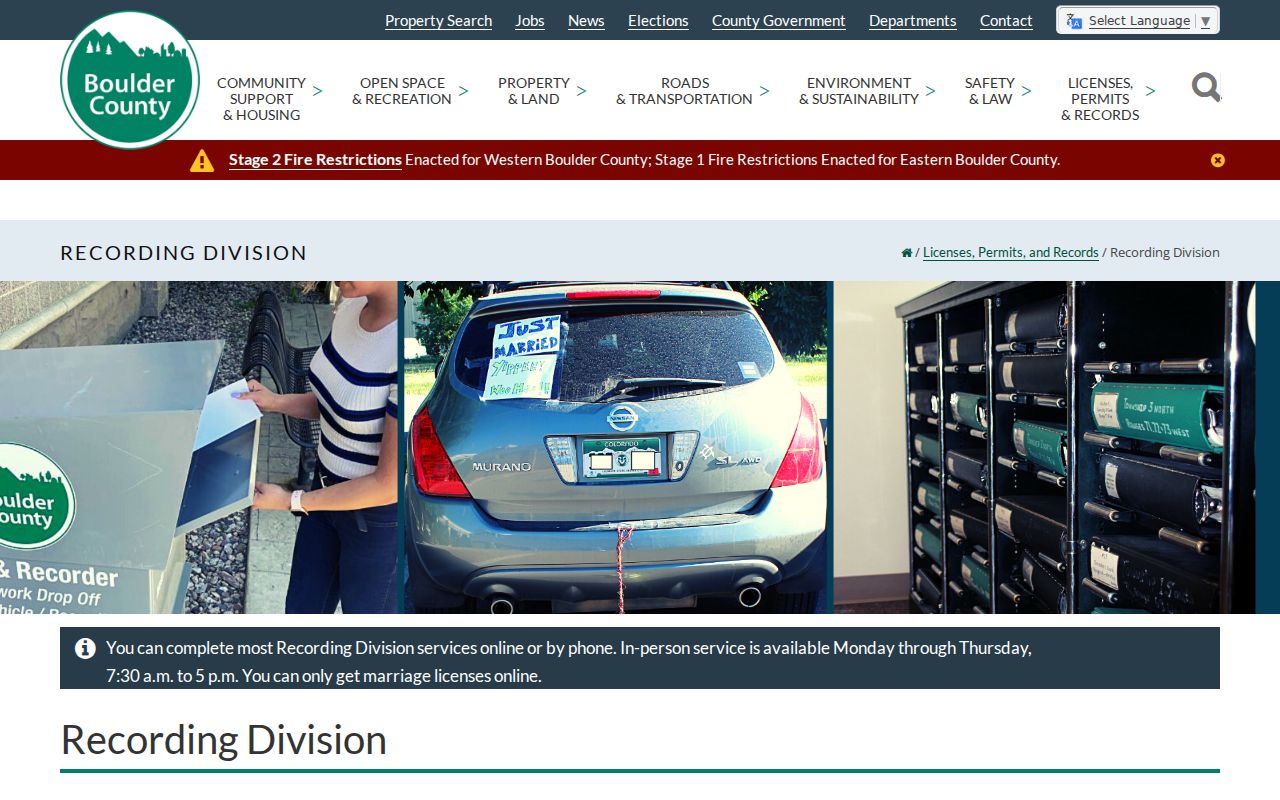
The recording interface is a name and document index, not a complete resident directory. A missing hit can reflect spelling, OCR, a different party role, an unindexed series, or a record-survival gap. Try several angles before concluding a record does not exist.
Current Boulder County Directories
Current sources in a Boulder County residents directory search answer different questions. The assessor and Treasurer are parcel and tax tools. Elections products contain only the fields authorized for that product. A recorder index names parties to documents. City clerks hold municipal actions, not a countywide household list, and neighborhood maps identify areas or coordinators, not private member rosters.
| Source | Named population or record | Custodian | Access boundary |
|---|---|---|---|
| Property Search | Parcel owner and mailing fields | Boulder County Assessor | Public current search |
| Recorder index | Grantors, grantees, and recorded parties | Clerk & Recorder | Index and watermarked images |
| Voter products | Authorized voter and election fields | County Elections and Colorado | Protected voters and fields withheld |
| Court docket | Hearing rows and case identifiers | 20th Judicial District | Full documents require a request |
| Municipal records | City actions, permits, or public files | Each city or town | Custodian and jurisdiction specific |
The sources overlap. They rarely say the same thing. One person can be a deed party, a taxpayer, a voter, a court party, or an obituary subject on different dates, so every result should carry its source label and inspection date. For a question about one person, use the resident-lookup workflow instead of a broad claim from a current directory.
Boulder County Voter Files
Colorado voter services offers a civic record route. Boulder County Elections does too. This is not an unrestricted residents list. The county describes several standard products. These include registered voter data, mail ballot and in-person voting reports, and master voter history. Rejected cure data rounds out the list. Fields vary by product. A voter record may list voter ID, name, residential and mailing address, registration date, status, and party. Affiliation date may appear too. It can also carry phone, gender, birth year, precinct, district, vote method, and election dates.
Plenty stays private. Social Security numbers are withheld. So are driver-license or state-ID numbers, month and day of birth, and signature. Email stays private too. Protected-voter information and ballot choice are also held back. Address Confidentiality Program participants must never be reverse-mapped through a public address field. Precinct labels cannot be projected backward either. An older election needs its own election-specific map.
The Boulder County Elections data-access route draws the line between products and requests. Standard reports are free downloads. Other map or data requests may require a cost estimate.
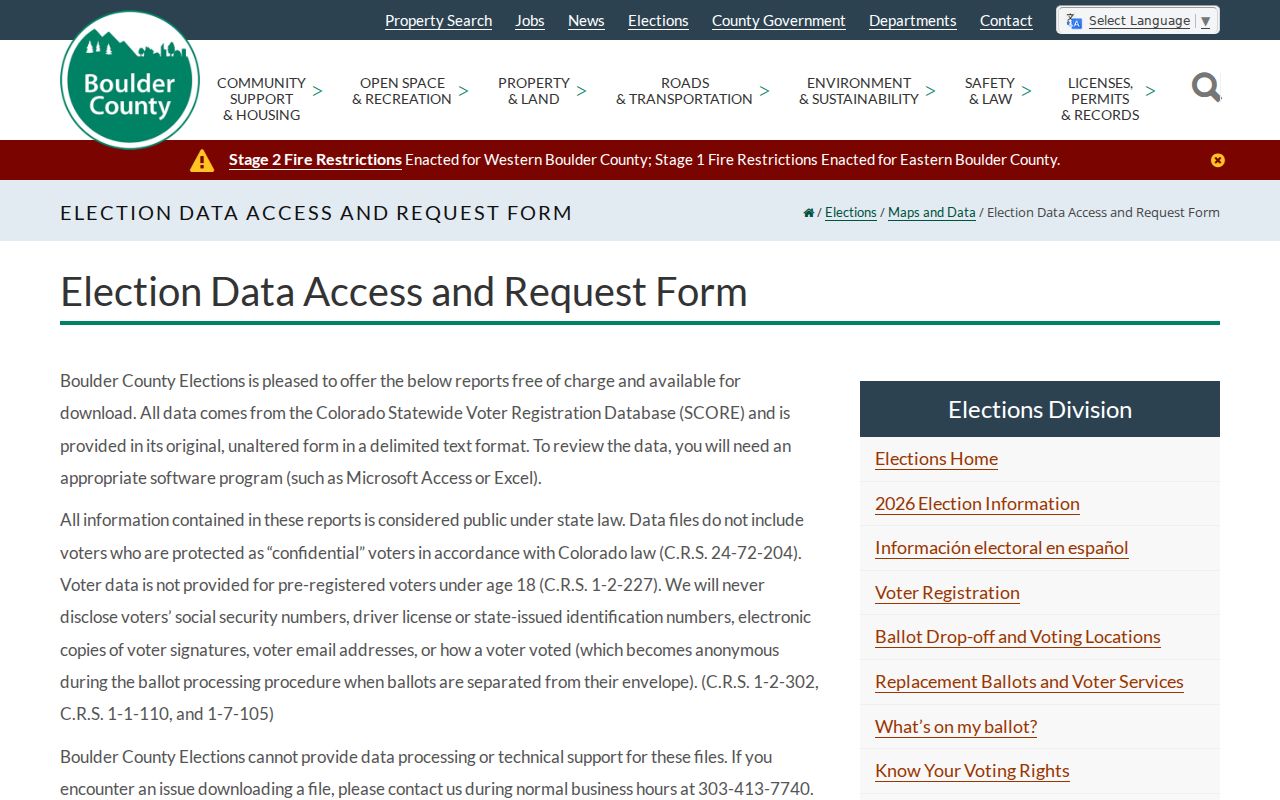
The election data image sits beside the privacy rules. A public field supports a dated civic lookup. It must not be merged with parcel, jail, or license details into a private profile.
Boulder County Court Dockets
When a name might surface in a state court hearing, the Colorado Judicial Branch docket search is the right starting point. Filters come first. You can select judicial district, county, courthouse, court type, division, date range, case year, case class, and sequence. Party controls separate an individual from a business. Attorney controls take a name or bar number. The search also requires a filter beyond the date.
A hearing row is not the whole case. Results can display date, time, duration, name, case number, hearing type, location, appearance type, and courtroom. Those fields show scheduling. They do not prove an outcome, expose every party, or open the full file. Municipal courts in Boulder, Longmont, and Lafayette run their own local jurisdictions. Federal matters sit in PACER instead.
For a specified order, disposition, register of action, judgment, probate item, or certified copy, use the Colorado court record-document request form. It collects requester contact, case and party information, document selection, and certification choice. Normal responses arrive within three business days unless extended, and document-specific fees are published.
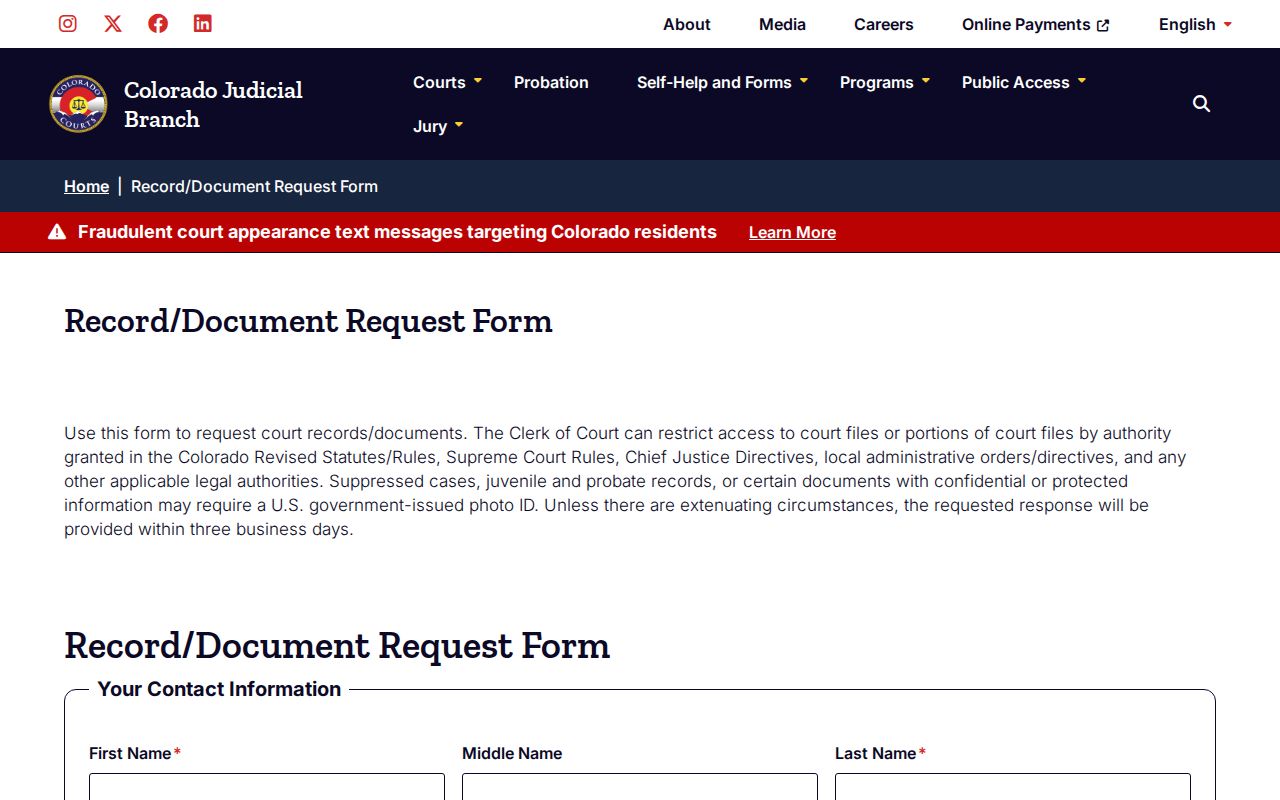
The request form turns a docket clue into a court document. Sealed, juvenile, suppressed, and protected records remain limited.
Boulder County Vital Records
Vital records need more care than a name search. Boulder County Public Health handles them. It issues Colorado birth certificates for births from 1904 to the present, and death certificates for deaths in Boulder County from 1901 to the present. The coverage rules differ sharply. A Boulder resident born outside Colorado is absent from the county birth series. A visitor who died in Boulder County may still fall under the death route.
| Record | Route and limit |
|---|---|
| Birth | County Public Health; eligible family or direct and tangible interest, identity and relationship proof |
| Death | County Public Health for Boulder County deaths; listed relatives, representatives, probate researchers, or credentialed genealogists may qualify |
| Marriage or civil union | Clerk & Recorder license and recording route; uniform historical opening date not located |
| Divorce | Boulder County Combined Court district file, subject to court restrictions |
| Older birth series | Colorado State Archives route for records at least 100 years old under its access policy |
Colorado keeps vital records confidential under C.R.S. §25-2-117. The fee schedule is simple. Current county pages list $25 for the first birth or death copy and $20 for each additional copy of the same record. An older application PDF shows different amounts. The current county page controls. A newspaper obituary or cemetery index can offer a historical lead, though neither counts as a certified certificate.
Historical Boulder County Directories
The historical side of a Boulder County residents directory begins with the Boulder Public Library local-history collection. Ella M. Travis prepared a digitized index. It covers Longmont and Boulder in 1892 to 1898, Boulder City in 1901 to 1903, and a 1904 county run naming Boulder, Lafayette, Longmont, and Louisville. Boulder City years 1905 to 1908 and 1911 follow. Carnegie holds hard copies. Call numbers run 997-2-1 through 997-2-4.
A directory entry can show a name and historical address, but it is a publication record, not current occupancy proof. The broad Boulder City run is documented from 1892 through 1983. Later annual holdings need a Carnegie check. The full collection and tracing method belong on the Boulder County city directory page.
Boulder County PropertyAlert
Boulder County PropertyAlert is a forward-looking tool when a recorded-document name matters. Registration takes an email and password, then email confirmation. Alerts follow owner names or documents. Autocomplete accepts variants and trust names. Common names invite false positives. Check each alert against the document and parcel rather than treating it as a title opinion. An alert proves neither ownership nor occupancy. It tells the registered email account that an entered name or document appears in the recording stream. For suspected fraud, the county points people to Sheriff Records at 303-441-3600. The official recording office, not an alert message, is where a document number and copy route get verified.
Note: PropertyAlert is a recorded-document notice service, so a name variant can matter as much as the main spelling.
After the 1932 Courthouse Fire
Boulder County record hunting has a real gap in it. Fire destroyed the original courthouse, the one laid with an 1882 cornerstone, in 1932. A replacement courthouse went up in 1934. The 1933 courthouse that stands today serves as a seat of county government. The working courts sit elsewhere now. So an early Boulder County record that seems missing may simply have burned, moved, gone unindexed, or landed with a different custodian. It helps to know where the old files might have drifted.
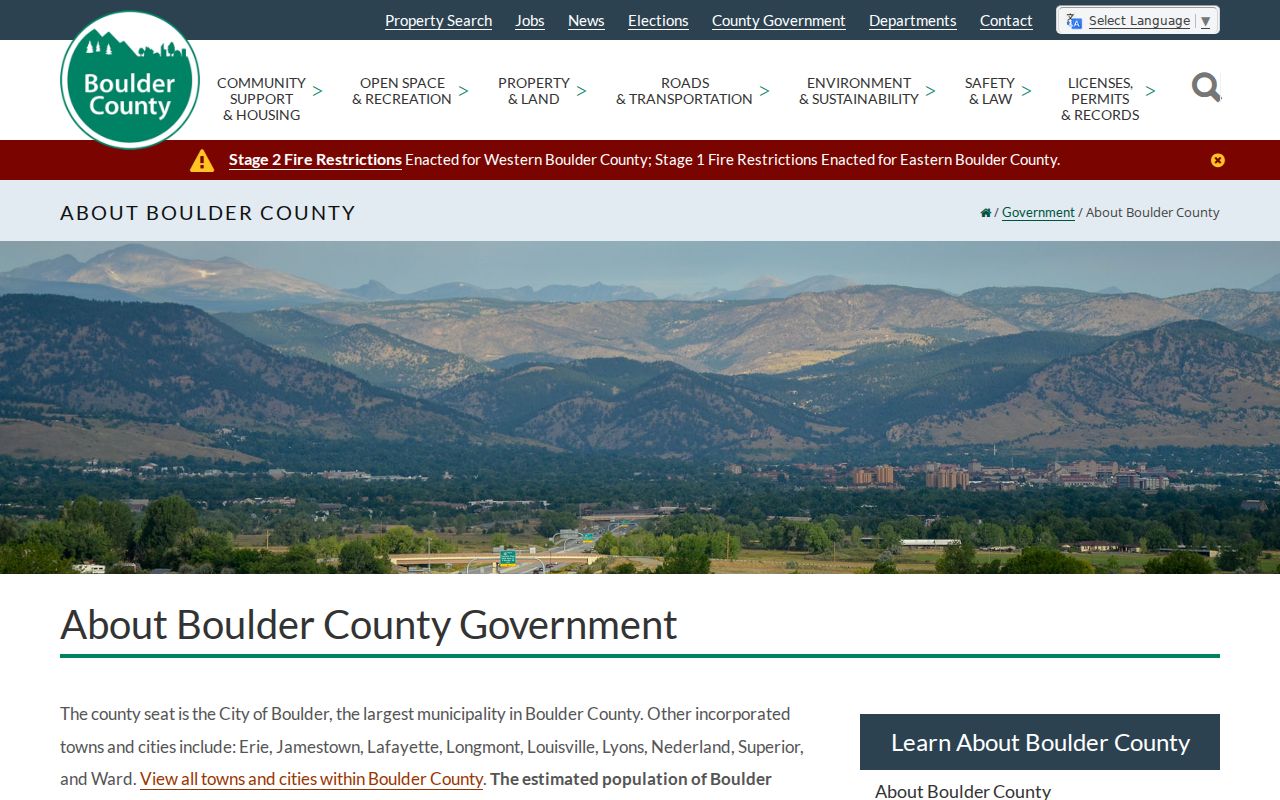
For the county's own account of its history and boundaries, the Boulder County government overview is the reference point. The image serves as a quick jurisdiction identity check. Treat it as orientation. Pair it with the recorder, the Archives, the Carnegie branch, the courts, newspapers, and municipal records. It is not assurance that every old file survived.
That 1932 fire is exactly why source reconciliation pays off in Boulder County. A deed can survive where a court file burned, and a newspaper, cemetery listing, city directory, or municipal record can preserve a name that a single county series lost.
Boulder County ZIP Geography
A ZIP code marks a mail delivery area. It is not a resident list or a legal neighborhood. Boulder County is full of shared ZIPs, such as 80027 for Louisville and Superior. Mountain ZIPs include 80455 for Jamestown and 80466 for Nederland. Some places carry a postal city that differs from both the municipality and the county jurisdiction. Gunbarrel and Niwot show why one address needs postal and legal context before you trust it in a residents directory or street directory.
- ZIP code
- A USPS delivery identifier that can cross a city, neighborhood, or county line.
- ZCTA
- A Census statistical approximation that is not the same as every current USPS ZIP.
- Mountain address
- A county emergency address whose number can express approximate driveway distance from the road start.
- Parcel
- A mapped land unit tied to an account and legal description, not a person or household.
Run the address through the USPS ZIP lookup first to normalize it. Then the Boulder County residents directory can treat the ZIP as one narrowing clue, with the assessor or Treasurer adding parcel and account context.
Boulder County Records Requests
When an index comes up empty, send the request straight to the custodian. That custodian is the one who actually holds the record. A good Boulder County request names the department, the record type, and the date range. Include any name or address variants, and a parcel, account, case, or document number. Add the format you want. Under CORA, requests go in writing or electronically. The county answers within three working days. An extension of up to seven more working days is allowed for extenuating circumstances.
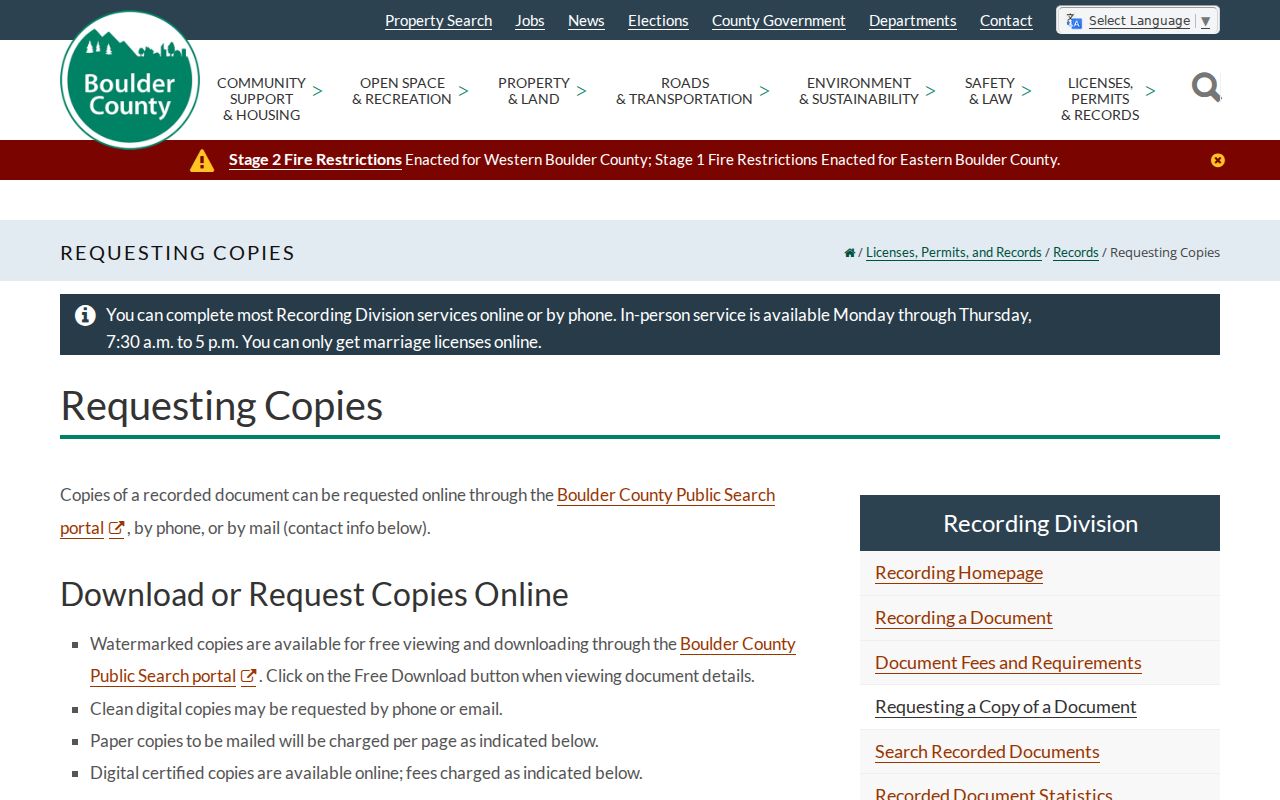
For copies, the county accepts online, phone, and mail requests. A mailed request needs the requester's name, phone, and mailing or email address. It also needs the document type, reception or document number, and copy type. Payment, postage, and a self-addressed envelope round it out when required.
The Boulder County public-record copy page spells out those routes. It also displays the differences among watermarked, clean, and certified copies.
Broader requests go through the Boulder County CORA portal, which publishes no single universal field schema. A narrow, specific request always gives the custodian a workable search path.
The two images belong together for one reason: an online request route changes nothing about which office holds the record, which exemptions apply, or what gets redacted.
Two Clues for Boulder County
A trustworthy Boulder County residents directory result rests on two independent clues. Which pair works best depends on the record. For property research, a parcel number with its legal description is hard to beat. For court material, a case number plus date and courthouse beats a bare name every time. A directory year and printed address can pair with an appraisal card, deed, map, census entry, newspaper item, cemetery record, or obituary.
| Official trail | Useful first clue | Second check |
|---|---|---|
| Property | Address, parcel, or account | Recorder legal description or later deed |
| Court | Party name and case number | Docket date, court, and requested document |
| Historical household | Directory year and printed address | Assessor card, census, newspaper, or cemetery |
| Vital event | Event, town, and date | Eligible certified record or independent index |
Lawful personal research. Public records in Boulder County are not a license to monitor, threaten, or repeatedly contact another person. Use the least personal information needed, respect protected and confidential records, and never use a result to stalk, harass, or harm anyone.
Every county, state, library, and court source carries its own date range and its own limits. A missing result never proves a person, address, or event did not exist. Confirm with the custodian before you lean on any record.