
Boulder County Resident Lookup Records
The useful record depends on what “verify” means. A parcel record can confirm an owner field and legal description. A docket can confirm that a hearing row exists. A vital certificate can establish a legal birth or death fact only for an eligible requester. A directory or obituary can place a name and address in a historical publication. The following coverage table keeps those claims separate.
| Record | What it confirms | Where | Access |
|---|---|---|---|
| Assessor parcel | Owner field, mailing address, situs, parcel, account, legal description | County Property Search | Public current search; not proof of occupancy |
| Recorder index | Grantor or grantee name, document date, type, number, legal-description lead | Boulder County Public Search | Index and watermarked image; clean copies fee-bearing |
| Court docket | Hearing name, case number, class, year, date, location | Colorado Judicial Branch | Public result row; full document request-based |
| Voter product | Authorized registration, precinct, or history fields | GoVoteColorado and Elections | Confidential fields and protected voters withheld |
| Vital record | Birth or death fact when an eligible requester obtains a certificate | Boulder Public Health or CDPHE | Identity, relationship, and direct-interest rules |
| Historical source | Published name, address, event, burial, or family clue | Carnegie, BGS, archives, newspapers | Index, scan, ledger, or inquiry route varies |
These sources can point in the same direction without becoming interchangeable. The source label is part of the evidence. “Recorded party,” “owner field,” “hearing row,” “listed at,” and “eligible certificate” are safer than a single claim that someone lives in Boulder County now.
Start a Boulder County Resident Lookup
A bare name produces same-name risk. Add the smallest useful anchor before opening many portals. A street or parcel points to Property Search and the recorder. A case number points to the Judicial Branch. A birth or death year points toward a confidential certificate route. A family-history question may need a directory, cemetery, newspaper, or obituary index. Record the spelling, initials, married name, town, and date exactly as known.
- Write the full name and one independent clue, such as a town, address, year, parcel, spouse, or case.
- Search the official source that matches the clue, then save the record type, date, jurisdiction, and identifier.
- Check a second source that answers a different question, such as deed plus parcel or obituary plus cemetery.
- Request the underlying document only when the index result supports a specific case, document, or eligible certificate.
- Publish or share the minimum necessary detail, leaving protected, confidential, and sensitive fields out.
A match is stronger when the independent clue is not copied from the same database. An assessor owner field and a recorder deed can be related, so add a date, legal description, newspaper, or court identifier where possible.
Boulder County Court Search Fields
The Colorado Judicial Branch docket search gives a structured starting point for one person. Location controls include judicial district, county, courthouse, court type, and division. Date controls include a range or specified date. Case controls accept a four-digit year, case class, and sequence. Party controls distinguish an individual from a business, while attorney controls accept a name or bar number.
Search results can show date, time, duration, name, case number, hearing type, location, appearance type, and courtroom. An appearance type is not a ruling, and a hearing row is not a full party list. The public docket also does not open every document.
The Colorado Judicial Branch docket route is the source for the field set. The capture below shows the result context a resident lookup should preserve.
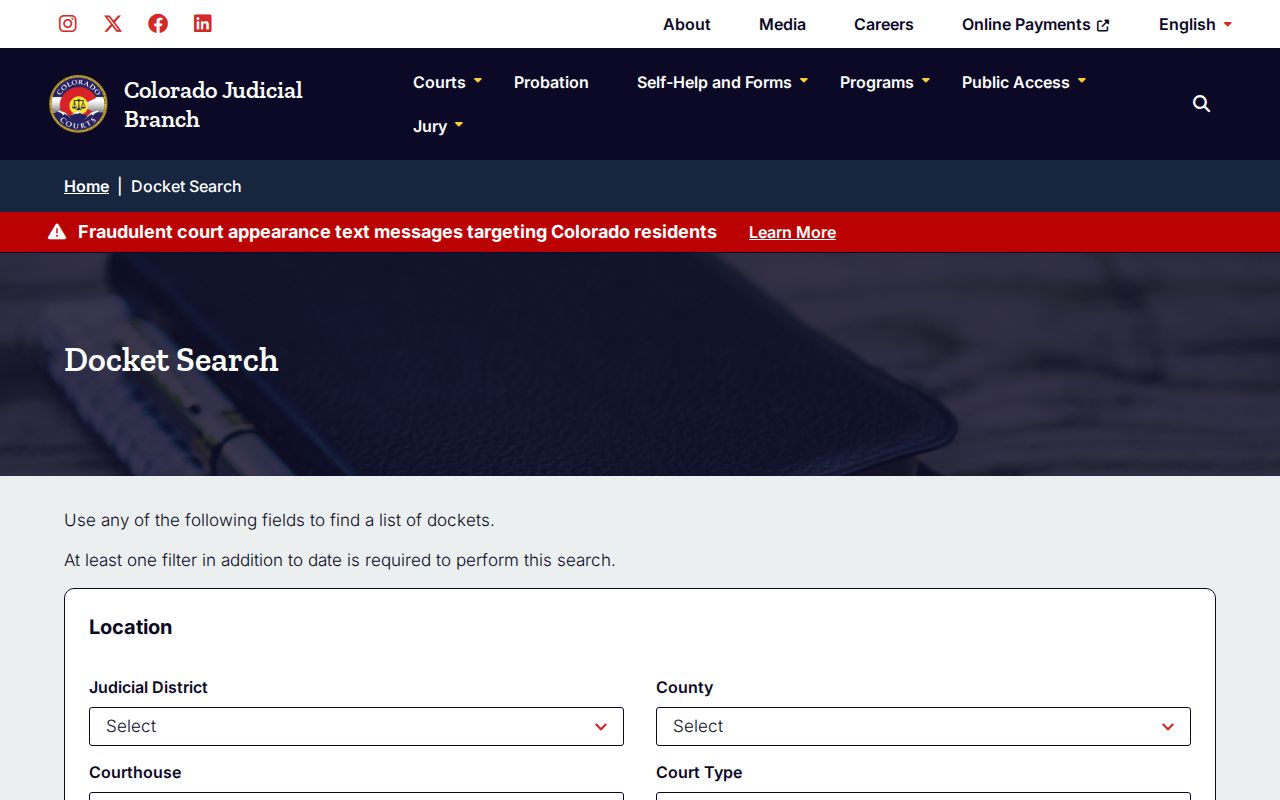
Save the case number and court location before requesting anything more. A docket search is a lead and a date-stamped result, not a finding about the person.
From Docket to Boulder Resident Records
When a docket row supports a specific document, use the Colorado record-document request form. The form asks for requester contact information, case number or type, year, county, party name, date of birth when known, and other identifying information. Choices include a Register of Action, orders, judgments, dispositions, protection orders, probate letters, wills, trusts, claims, applications, and certified or exemplified copies.
The form lists $0.25 per page, a $5 name search, a $20 certified or exemplified document charge, and other document-specific amounts. Research or redaction after the first hour is listed at $30 per hour. A normal response is three business days unless extended, and an ID may be required for suppressed, juvenile, probate, or protected material.
Use the official court record request form with a narrow request. Probate files and attachments can have their own access limits. Boulder Municipal Court, Longmont Municipal Court, and Lafayette Municipal Court are separate routes for local ordinance and city matters.
Recorded Names in Boulder County
The Clerk & Recorder public search is the main official historical-name route for recorded documents. Search grantor and grantee separately, then narrow by document type, subdivision, recorded date, document number, legal description, or OCR full text. The office's categories include deeds, deeds of trust, liens, plats and maps, foreclosure documents, marriage licenses and civil unions, mining claims, assignments, covenants, and UCCs.
Recording material dates to 1860 according to the office's records-history statement, but the online index and image cutoff was not stated. Watermarked images are available through the public route. Clean and certified copies use separate fee-bearing paths. A person named in an instrument is a recorded party, not automatically a current owner or resident.
A useful sample record inventory includes the printed party name, document or reception number, recorded date, document type, legal description, and whether an index or image is available. Preserve each field before comparing the name with an assessor parcel.
Boulder County Vital Eligibility
Birth and death records are not open name indexes in the ordinary sense. Boulder County birth-certificate guidance covers Colorado births from 1904 to the present, while the county death-certificate route covers deaths in Boulder County from 1901 to the present. The route is eligibility-based. Birth access can involve immediate family or direct and tangible interest. Death access includes listed relatives, legal representatives, probate researchers, and credentialed genealogists under the county's stated rules.
Current county pages list Boulder and Longmont service locations, identity requirements, online, mail, and in-person routes, and $25 for the first copy with $20 for additional copies of the same record. An older application PDF shows different amounts, so the current page controls. Colorado vital records are confidential under C.R.S. §25-2-117.
Marriage and civil-union records follow the Clerk & Recorder, while divorce files belong to the district court. Birth records at least 100 years old have a Colorado State Archives access route under its policy. A public obituary or cemetery index can be a historical clue even when the certificate itself requires eligibility.
Boulder County Historical Resident Checks
For a past resident, Carnegie and the Boulder Genealogical Society provide stronger local routes than a modern name directory. Carnegie holds Boulder and Boulder County newspaper microfilm from 1869 to the present, obituary index ranges from 1859 to 1925 and 1960 to the present, mortuary and burial records, church histories and directories, oral histories, maps, photographs, and directory material. BGS lists marriage, obituary, cemetery, census, family-file, mortuary, and Colorado Archives indexes.
The digital local-history archive can return photographs, clippings, documents, correspondence, ledgers, postcards, diaries, maps, and posters. Search names with a date, place, spouse, parent, cemetery, or event. Keep an exact page, call number, item identifier, or collection label. A scan supplies context that a short index entry may omit.
The historical city directory shelf is described fully on the Boulder County city directory page. A current one-person lookup should borrow the historical clue, not treat a directory address as a present fact.
Boulder County Voter Fields
Colorado voter services and Boulder County Elections are useful when the question concerns registration or election geography. The county describes products such as registered voter data, master voter history, mail ballot and in-person voting reports, and rejected cure data. Public fields can include voter ID, name, address, registration date, party, status, phone, precinct, district, birth year, gender, and vote-method dates depending on the product.
Confidential fields include Social Security number, driver-license or state-ID number, month and day of birth, signature, email, protected-voter information, and ballot choice. Address Confidentiality Program participants must not be reverse-mapped. A voter-file absence is not proof that someone moved or never registered.
The Colorado voter service route is the official entry point, while Boulder County Elections separates standard reports from other data or map requests. The image below is a route reference, not a reproduced person record.
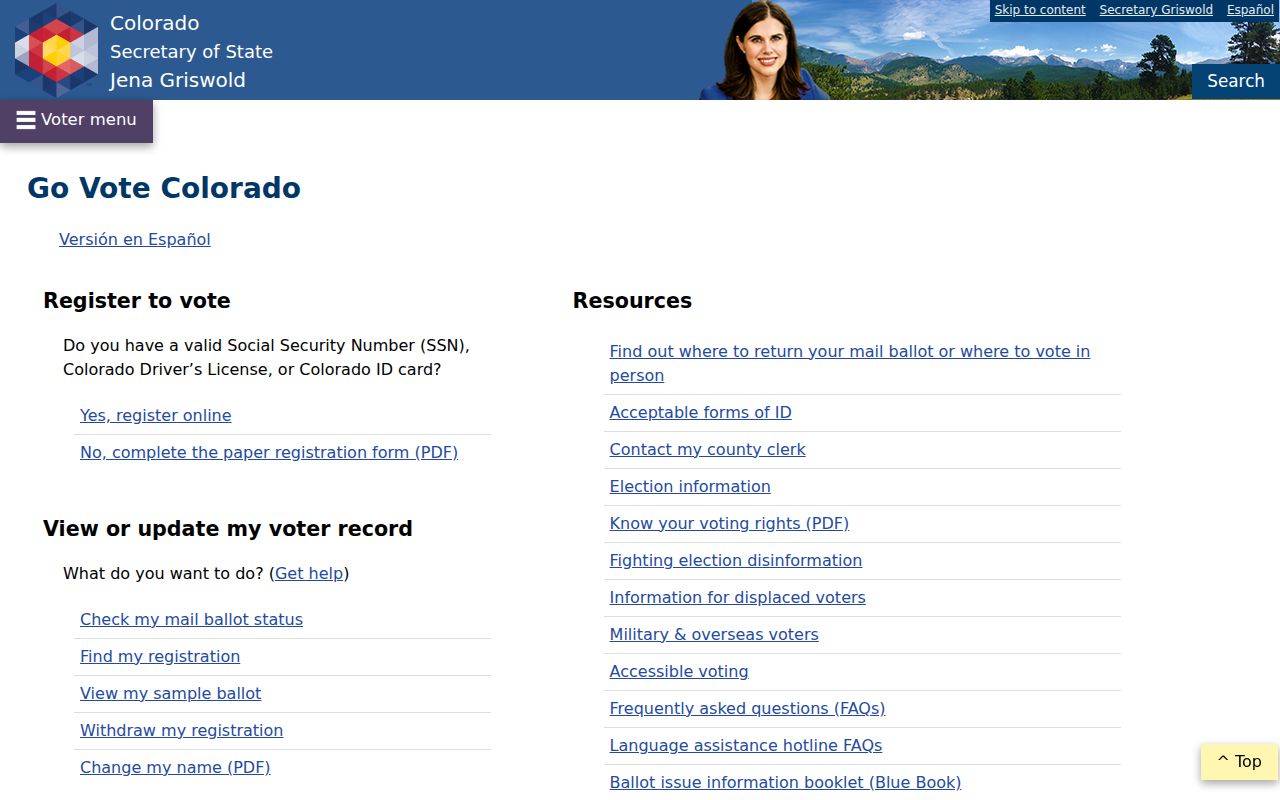
Use an election date and precinct context with a voter result. Do not merge voter fields with unrelated current sources to build a private profile.
Current Boulder County Status Sources
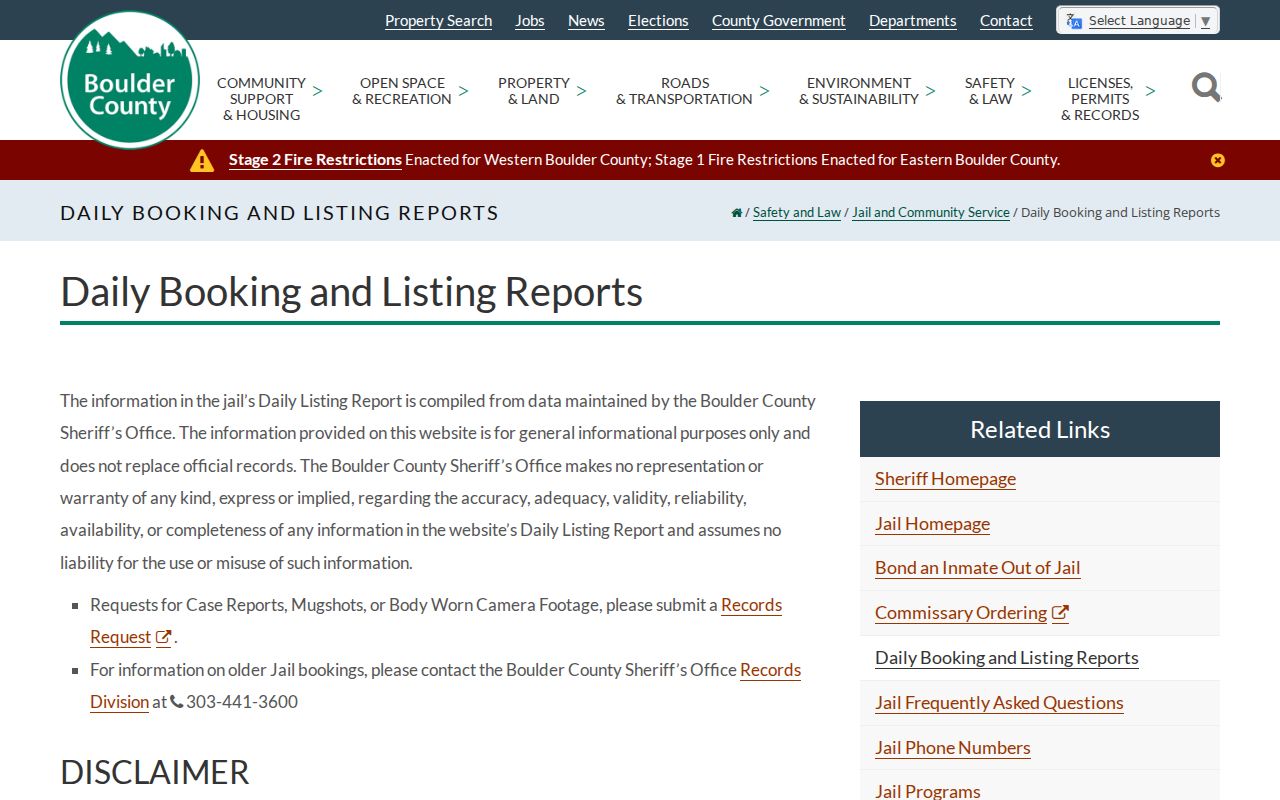
Jail, DOC, and registry records are narrow and time-sensitive. Boulder County's Daily Booking and Listing Reports provide a current listing and daily release route. Older bookings and booking photos go through Sheriff Records. The Colorado Department of Corrections search accepts DOC number, last name, first name, gender, and a CAPTCHA. The CBI registry is a statutory registry updated hourly, with name, date of birth, address, offense and offense date, and aliases subject to exclusions and disclaimers.
These systems are not interchangeable. A current jail listing is not a court disposition. A CBI result is not a complete criminal or civil record. A person can be absent from one current source and appear in another, or be protected from public display.
The Boulder County jail listing route shows the current-report path.
For a narrow registry question, the Colorado Bureau of Investigation registry agreement is the official entry point.
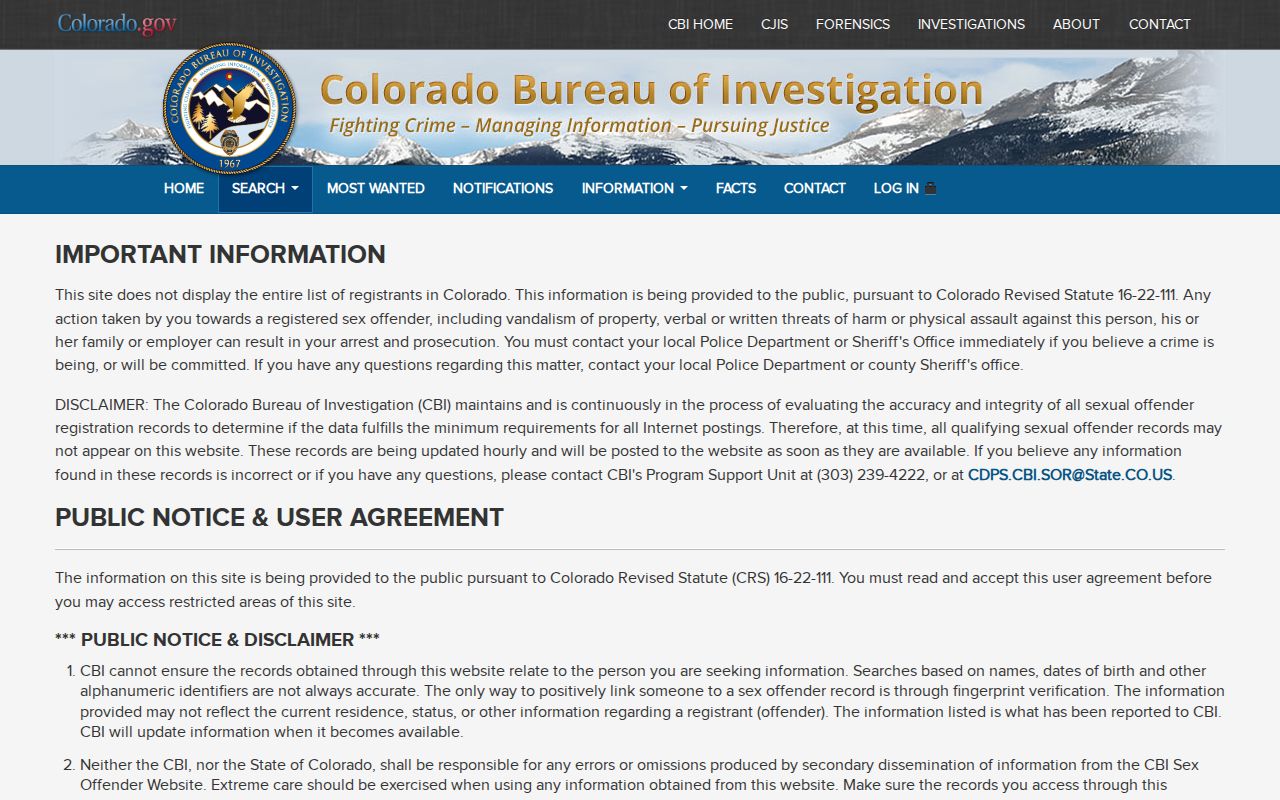
Read both images with the agency's identity warning. A same-name result needs date, agency, and official context.
Same Names in Boulder County
Same-name errors are common when a county has a large city, mountain towns, and multiple municipalities. Search initials, middle names, married or unmarried surname forms, trust names, OCR variants, and “et al.” parties. Compare the town label with the parcel or court location. Do not use a registered-agent or filing address as a personal residence.
Two state systems can add a record-specific check. The DORA lookup accepts a license number, business or DBA, first, last, or maiden name, state, ZIP, and credential detail. The Secretary of State filing search accepts business, trade, trademark, ID, and document criteria. A credential or filing confirms a record in that system, not a full biography or current location.
Great Colorado Payback is another narrow name route when an unclaimed-property question includes a former ZIP or organization. A possible match is only a lead; the state validates a claim separately.
When the name is tied to a street, switch to the Boulder County street directory and let the parcel, legal description, and date provide the anchor. When the purpose is an heir or family-history question, use the court, obituary, cemetery, and directory chain instead.
- Docket
- A court schedule or result row, not the complete case file.
- Index
- A finding aid that points to a record; an image or certified copy may require another step.
- Certified copy
- A custodian-issued copy with certification, subject to access and fee rules.
Limits on a Boulder County Lookup
A resident lookup should state what the source does and does not show. Assessor owner and mailing fields are not occupancy proof. A court name is a hearing-result field. A directory entry is a historical publication. A cemetery entry indicates burial context, not necessarily death place. Vital records, voter fields, court files, and ACP information may be confidential or protected.
Lawful use. Use public-record routes for personal, lawful research, family history, civic understanding, and document verification. Do not use a Boulder County resident lookup to stalk, harass, intimidate, or harm anyone.
Colorado's Address Confidentiality Program gives eligible survivors a substitute address and mail-forwarding protection. A missing or substituted address must not be reconstructed through parcels, maps, voter files, or historical directories. Keep the minimum necessary name detail, record the source date, and send legal or correction questions to the custodian.